
This is not legal advice and we are not the Illinois Secretary of State or any state agency. Rules and fees change. Confirm anything that affects you in the 2026 Rules of the Road before you go.
The path
Illinois calls your first driving credential an instruction permit. A basic license to drive a car is a Class D license. You must be at least 16 to get that license. If you are under 18, follow the steps below in order (Rules of the Road).
- Enroll in approved driver education, unless you are already 17 and 3 months old.
- Gather papers for your date of birth, Social Security number, residency, and signature.
- Pass the vision screening and the written exam at a driver's license facility.
- Get your instruction permit. The printed fee is $20.
- Practice with a licensed adult age 21 or older, with one year of driving, seated in front.
- Finish 50 supervised hours, including 10 at night, and hold the permit nine months.
- Pass the driving exam, unless a Cooperative Driver Testing Certificate covers it.
- Get your Class D license.
An approved course includes at least 30 hours in class and six hours behind the wheel in a passenger vehicle (Rules of the Road).
If you are 18, 19, or 20, you may need a six-hour adult course before a license. You need it when you have never been licensed and never finished approved driver education. Only a provider the Secretary of State certifies may teach it (Rules of the Road).
The 2026 book prints the instruction permit fee as $20. It says fees can change. It points you to ilsos.gov for the current list (Rules of the Road).
What to bring
For a first standard driver's license, bring proof of the items below. One paper may cover more than one item. Photocopies are not accepted (Rules of the Road).
- Date of birth
- Social Security number
- Illinois residency — one document
- Your signature
A first REAL ID also needs proof of identity, including citizenship or lawful status. You need two documents that show Illinois residency. You still need date of birth, Social Security number, and a signature. If an identity paper uses an older name, bring the record that links the names (Rules of the Road).
The facility compares your signature and takes your photo. You turn in any Illinois license, state ID, or instruction permit you already hold (Rules of the Road).
Under 18, a visit to get the license also calls for the papers below (Rules of the Road).
- Your instruction permit
- Acceptable identification
- Affidavit/Consent for Minor to Drive, if a parent cannot come with you
- Cooperative Driver Testing Certificate, if you have one
- A signed 50-hour driving log
A parent or legal guardian must consent in writing for a license at 16 or 17. If that person cannot come, a legal guardian or a responsible adult over 21 may sign the affidavit (Rules of the Road).
The instruction permit
You can get an instruction permit at 15, 16, or 17. Bring proof from your driver education provider that you are enrolled. The proof may instead say you will start class within 30 days. At 17 and 3 months or older, you may apply without driver education (Rules of the Road).
The permit is valid for 24 months. At 15, 16, or 17, you hold it at least nine consecutive months before a license. You must pass the vision screening and the written exam for your class. Those results last until the permit expires (Rules of the Road).
Vision
Every license applicant needs a vision screening, or a vision form dated within six months. You need acuity of at least 20/40, with or without corrective lenses. Acuity from 20/41 to 20/70 limits you to daylight driving. You need at least 140 degrees of side vision. If you wear glasses or contacts, the license will require them when you drive (Rules of the Road).
Who rides with you
You may drive with your behind-the-wheel instructor. You may also drive with a parent, legal guardian, or responsible adult. That adult must be 21 or older, hold a valid license, and have one year of driving experience. That person sits in the front seat beside you (Rules of the Road).
Under 18, you need 50 supervised hours before a license at 16. Ten of those hours are at night. The hours are on top of driver education. You can track them on a log from the Parent-Teen Driving Guide (Rules of the Road).
The written exam
The 2026 Rules of the Road do not print a question count. They do not print a pass mark. Both sit in the Secretary of State's written-test rule. No time limit is printed in the book or the rule (Rules of the Road, written-test rule).
For a Class D license, the written test has a minimum of 35 questions. You must answer 80 percent of them correctly. On a test of 35, that is 28 right, so you may miss 7. The rule says minimum, and the book prints no higher count (written-test rule).
The basic written exam asks you to know signs by shape, color, or symbol. You also identify signals and pavement markings. You answer multiple-choice and true-or-false questions. Those questions cover traffic laws, safety rules, crash prevention, and vehicle equipment. The book presents that as the basic written exam (Rules of the Road).
The testing rule gives the Class D test in English. It may also be given in other languages the Secretary of State finds necessary. That choice depends on identifiable demand. The rule does not name the other languages (written-test rule).
If you cannot read the test, the rule says it may be given orally. You can request an oral exam in person at a driver's license facility. Oral exams are offered Monday through Thursday. They serve a language barrier or a reading or learning disability (Rules of the Road).
If you cannot read English or another language that is offered, you may still take the test. An interpreter may help. If the facility does not have one ready, you bring your own (written-test rule).
You get three attempts to pass each exam. The year runs from the day you paid the application fee. The book does not print a separate retake fee. Cheating fails that exam. You then wait 30 days before you try again (Rules of the Road).
You take this exam at a Secretary of State driver's license facility. The book does not describe an online Class D written exam (Rules of the Road).
On this site, a practice test shaped like the real one is 35 questions with 7 misses allowed. That size is the rule's minimum. Seven misses is what 80 percent allows on a test of that size (written-test rule).
Practice that test here, free. A right answer passes without comment. A miss is explained where it happens, because that is the moment it teaches.
From instruction permit to Class D license
You must be at least 16 to receive a Class D license. At 16 or 17, you need driver education on your record, the 50 hours with 10 at night, and nine consecutive months on the permit. You pass the three parts: a vision screening, a written exam, and a driving exam (Rules of the Road).
Bring your permit, identity papers, signed hour log, and consent if it applies. The office must already show that you finished driver education (Rules of the Road).
A high school course with a combined grade of A or B can waive the facility driving exam. Your instructor and your parent or guardian sign the Cooperative Driver Testing Certificate. That certificate expires on the same day as your instruction permit. It is not given extra time (Rules of the Road).
Some birthdays are spot-checked at a facility. Those teens still take the driving exam there, even after a school road test. The book does not list the spot-check dates (Rules of the Road).
If your license is issued before the permit expires, you pay no added license fee. At ages 18 to 20, the printed license fee is $5. At ages 21 to 68, the printed license fee is $30. The book says fees can change and sends you to ilsos.gov for updates (Rules of the Road).
If you are 21 or older and driving for the first time, adult driving school is suggested. The book does not require that school (Rules of the Road).
If you are 18, 19, or 20 and have never been licensed, you need the six-hour Adult Driver Education Course. You also need it if you never finished approved driver education. A classroom course or an online course can qualify when the provider is certified (Rules of the Road).
A driver's license is valid for four years and expires on your birthday. Under 21, it expires three months after your 21st birthday (Rules of the Road).
After you pass and pay, you receive a paper license valid for 90 days. The permanent card is mailed, usually within 15 business days (Rules of the Road).
Until you turn 19, phone use while driving is banned, even hands-free. You may call police, a health care provider, or emergency services in an emergency (Rules of the Road).
If you are under 18
Illinois uses a Graduated Driver Licensing program with three stages. It usually begins at age 15. The stages run through age 20 (Rules of the Road).
Permit stage
The book heads this stage for drivers age 15. The night limit also covers the permit stage for anyone under 18. If you are still on a permit at 16 or 17, do not treat the night limits as gone (Rules of the Road).
- Sunday through Thursday, you do not drive from 10 p.m. to 6 a.m.
- Friday and Saturday, you do not drive from 11 p.m. to 6 a.m.
- A local curfew can set different hours.
- You hold the permit at least nine months.
- You practice at least 50 hours, including 10 at night, with a parent or an adult age 21 or older who has a valid license.
- You must not pick up a driving infraction, an underage alcohol case, or court supervision in that nine-month phase.
- Only one passenger may sit in the front seat.
- The back seat may hold only as many people as there are belts.
Initial license, ages 16 and 17
The night hours match the permit stage. For the first 12 months, or until you turn 18, whichever occurs first, you may carry only one passenger who is under 20. A sibling, stepsibling, child, or stepchild does not count toward that limit. After that period, one person may sit in front, and the back seat follows the belts (Rules of the Road).
You need a conviction-free record for six months before you turn 18. A conviction in this stage can keep limits in place after 18. The phone ban continues until you turn 19 (Rules of the Road).
Full stage, ages 18 to 20
No age-based driving limits apply if you cleared the initial stage. If you did not, the earlier limits can continue. The phone ban still lasts until age 19 (Rules of the Road).
A parent or guardian who consented can cancel your license for any reason until you turn 18. You would apply again, take the exams, and pay the fees (Rules of the Road).
Driving-exam day
Every new driver takes a driving exam. Drivers ages 16 and 17 take it unless a cooperative certificate waives it. You take the exam at a Secretary of State facility (Rules of the Road).
The vehicle must be in the weight class on your application. It must be licensed and insured. You show proof of insurance at the exam. It needs a valid registration sticker and valid Illinois plates on the front and rear. If it is registered outside Illinois, it must follow the registration rules where it is registered. A licensed driver brings the vehicle to the facility (Rules of the Road).
Only the examiner rides with you. Children and pets cannot ride along or wait alone in the facility. You and the examiner wear safety belts. You fail automatically if you break a traffic law or drive dangerously (Rules of the Road).
You get three attempts within one year of the day you paid the application fee. The book does not print a separate price for another try (Rules of the Road).
What you will be asked to do
- Check the controls, including the parking brake and the mirrors, before you move.
- Set the seat, belts, and mirrors before the vehicle moves.
- Back about 50 feet, slowly and smoothly, while you look to the rear.
- Turn about through an alley on the left, then back out on your side of the street.
- Park uphill and start uphill.
- Park downhill and start downhill.
- Obey signs, signals, right of way, and lane lines, and use your turn signals.
Those tasks are the ones the book says you are graded on (Rules of the Road).
Hill parking
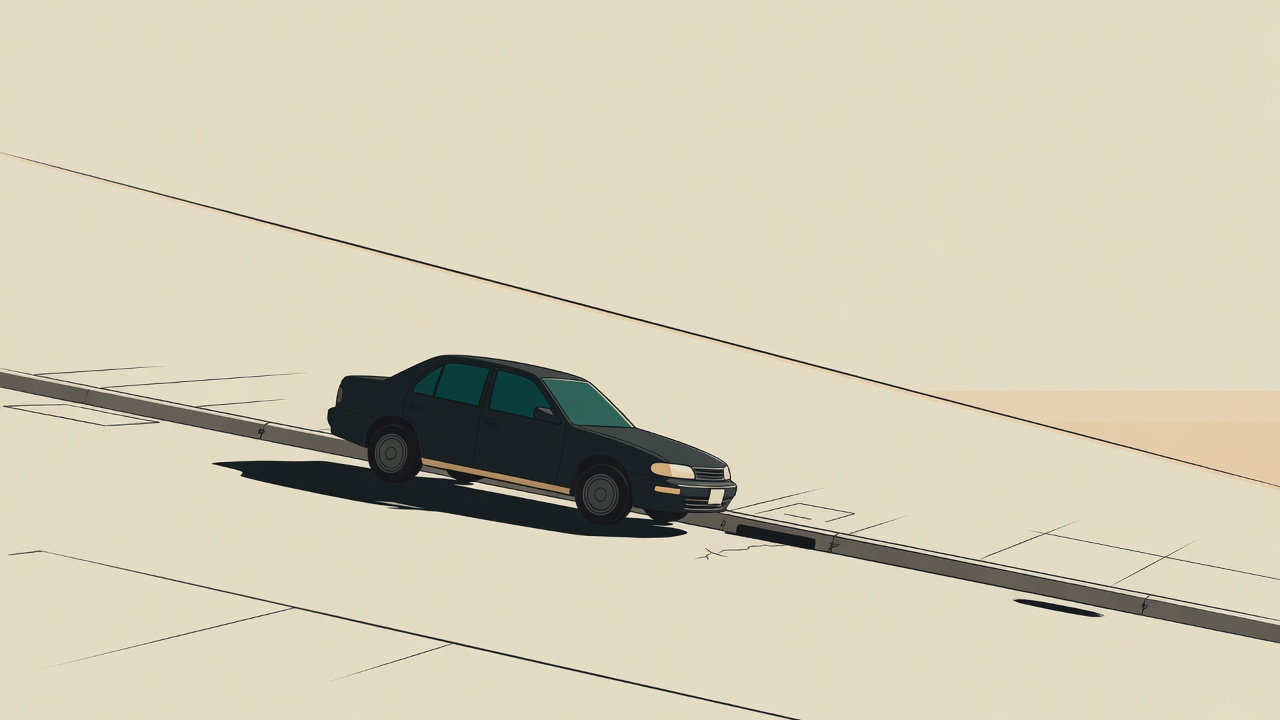
- Downhill with a curb, turn the front wheels toward the curb.
- Uphill with a curb, turn the front wheels away from the curb.
- With no curb, turn the wheels toward the side of the road where you parked.
The driving exam points you to those hill-parking steps (Rules of the Road).
Moving here with a license
If you move to Illinois and hold a valid license from elsewhere, you may drive at first. You must get an Illinois license within 90 days, or before your current license expires, whichever comes first (Rules of the Road).
- A visitor may drive through on a valid license from home.
- A student at an Illinois college may drive on a valid home license. A spouse and children may do the same.
- On active duty, you, your spouse, and dependent children living with you may drive on a valid home license.
Those are exemptions the book prints. They are not a new Illinois license (Rules of the Road).
The book and the testing rule do not print a waiver of the written exam for a new resident. They do not print a waiver of the driving exam either. You bring the same kinds of identity papers as any first applicant. You surrender every out-of-state license and ID before Illinois issues yours (Rules of the Road).
If you had a deferral while serving outside the country, you may drive for the first 120 days after you return. Your spouse and dependent children living with you may do the same. A civilian employee of the armed forces who had a deferral gets those 120 days too (Rules of the Road).
Practice the written test here
Free practice is real practice. Answers show where they come from. The test-like mode stays quiet on a right answer and explains every miss. Study the Rules of the Road, then start here.